

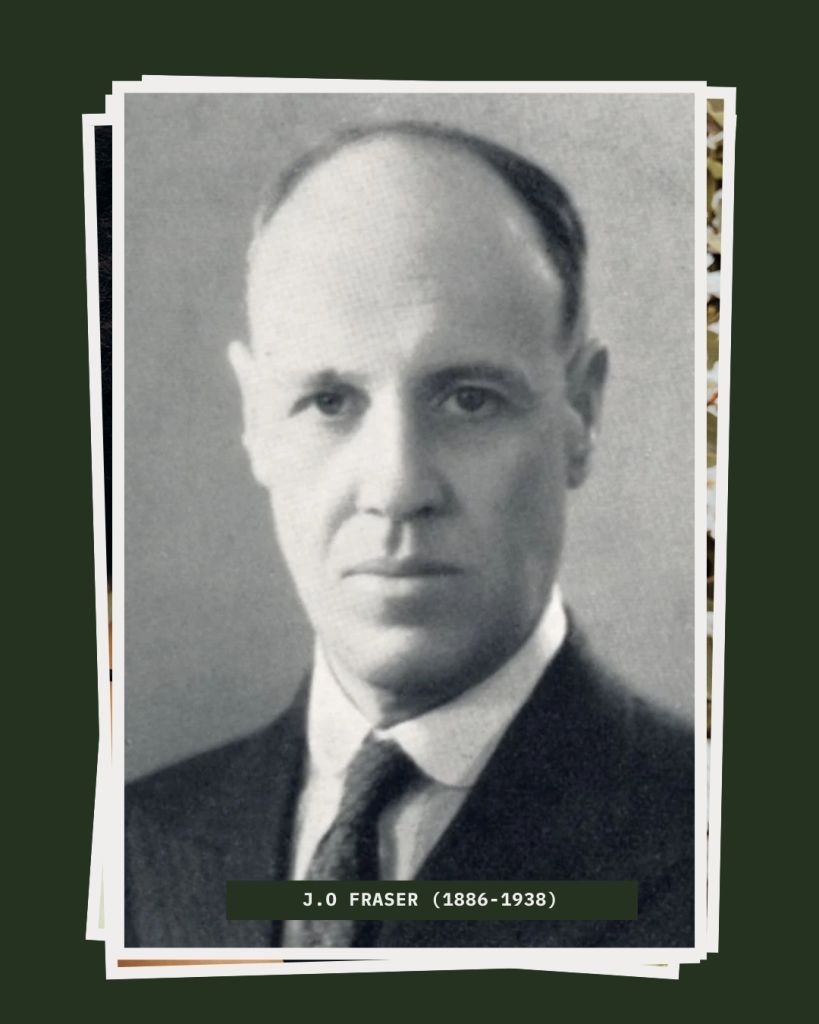
In this article, I want simply to share a short paragraph from J.O. Fraser’s biography, which in a few short words says a great deal.
“Some Europeans, both missionary and otherwise, thought Fraser to be an eccentric. Frank Dymond, whose own exploits as a Methodist missionary make stirring reading, remarked to his daughter one day that ‘there was a strange chap who lives up in the mountains doing a kind of lone missionary work. No one seems to know much about him.’ ‘A strange chap’ he must have seemed as he set out for Tantsah in the autumn of 1914. Not that he wanted to go alone. He was companionable by nature, but he had to accept the fact that the burden he felt for the tribes of this area was a personal one. Besides, no one else could be spared to help him.”
(Source: Mountain Rain, a biography of James O. Fraser by Eileen Fraser Crossman)
J.O. Fraser was “companionable by nature”, but his call to the Lisu people, coupled with the fact that the China Inland Mission at that time couldn’t spare any other workers to labour with him, meant that he was not only alone, but he was also misunderstood – “a strange chap”. If that is a problem for the pioneer missionary in terms of the opinion of those on the field around him, how much more is it so in terms of the views of those back home in his sending church. Alone and misunderstood.
>>The Parallel Experience of Adoniram Judson.<<
After the death of his beloved wife Ann in 1826, Adoniram Judson spiralled into a profound depression. He retreated into the Burmese jungle, built a hut he called The Hermitage, and lived in near-total isolation for 40 days. He ate minimal rice, dug his own grave, and spent hours contemplating death. Locals feared he’d be eaten by tigers. His survival was seen as miraculous.
There were powerful reasons for that loneliness. During the Anglo-Burmese War, Judson was imprisoned for 19 months under brutal conditions. He was hung upside down at night, shackled, and kept in filthy, overcrowded cells. His wife Ann fought tirelessly to keep him alive, bribing guards and bringing food. Yet even with her devotion, Judson endured extreme physical and emotional isolation.
Judson buried several children and two wives in Burma. Ann died young after sacrificing her health for his survival. His second wife, Sarah Boardman, also died after years of missionary work. These losses compounded his loneliness, even as he continued his ministry among the Burmese and Karen peoples.
After his jungle exile, Judson resumed his work with renewed passion. He often travelled alone by canoe into remote, tiger-infested regions to reach unreached tribes.
John Piper described Judson as a “seed that fell into the ground and died,” echoing Jesus’ words in John 12:24. His suffering bore immense spiritual fruit – over 100 churches and thousands of believers in Burma. Yet the cost was staggering in terms of his isolation and loneliness.
Why Missionaries Often Feel Lonely:
• Cultural and Language Barriers: Difficulty in expressing oneself or forming deep relationships.
• Pressure to Perform: Feeling the need to appear spiritually strong and successful to supporters.
• Transient Community: Constant turnover among expats and colleagues leads to repeated loss.
• Changed Identity: Returning home often feels alienating; both the missionary and their community have changed.
(Source, OMF, USA.)


